


$6,800 installed is the lowest we saw an installed air conditioner sell for in Arizona in 2025.
On the other end of the spectrum, we saw a single system installation go in for $39,000 in 2025, too.
But I’ll be honest; most folks neither need nor want either of these extremes.
The average price of an installed air conditioner in Arizona was $15,468 in 2025. This price can vary greatly based on the type of system, the size of your house, and the quality of your home's insulation.
Now, you might be thinking, "But I know a guy who'll do it for 7,500 bucks." Remember, there are considerably more companies selling systems for over $16,000 than there are small operators installing systems on the cheap for beer and weed money.
We’ve never found that “any system” is better than the “right system” for your comfort needs, the environment’s needs, and the needs of the system itself. We are always sad when we have to rip out a builder-grade 3-year-old system that was poorly installed.
The most important thing to know is the true value of a high-quality installation. You really should get what you pay for. We also have to take into consideration the refrigerant mandates still haunting us in January 2026, as well as the uncertainty of available rebate programs.
Let's break down how this all works.
Factors Affecting Your Specific AC Price
Prices will range drastically based on nine important factors:
- The size of the system your home needs
- The type of system you purchase
- The features that actually benefit you the most
- The warranty provided
- Changes in refrigerant
- The size of the company installing it
- The quality of the installation
- The level of insulation in your home
- The age and condition of duct work in your home
1. System Size
Approximately 24% of new AC systems in Arizona are incorrectly sized for the house they're installed in. Of these, 83% are oversized due to one of three reasons:
- Incorrect ductwork size and design, causing ineffective (and invisible) airflow issues.
- Salespeople who don't have a clue how to size equipment properly.
- No consideration for additions or lack of insulation.
The remaining 17% are undersized, mainly because undertrained salespeople fail to account for homes that have been renovated. In some cases, lazy salespeople just match the size of the existing equipment, assuming it's good enough. With meaningful changes in refrigerant, this leads to AC systems that struggle to keep up when it gets hot.
Why does size matter? Because you want your system to last as long as possible at the lowest cost of ownership without jacking up your airflow.
2. System Type
Air conditioners suited for Arizona heat come in three primary designs:
- Package Systems
- Split Systems
- Ductless Mini Splits
Package systems are the most common in Arizona, followed closely by split systems. Ductless mini-splits are most often used as additional comfort control to a primary system in specific rooms.
You also have two primary fuel sources when it comes to air conditioning in Phoenix, and each of these affects the HVAC system design.
- Dual Fuel Systems (Gas and Electric)
- Electric Heat Pump Systems
The reason your HVAC System type matters in 2026 revolves around government initiatives to switch people off gas and into electric heat pump systems. While it is true if you have a rooftop package unit, it will cost nominally less than a split system unit tucked into your garage or closet; it’s the cost of converting to an electric heat pump that makes up the difference in spend when making a change.
It’s important to know that over 70% of electrical panels are not prepared to handle the load of a new Heat Pump HVAC system in Arizona. You may need to upgrade your electrical panel to be able to manage a more modern household. Depending on your home’s needs, this could be a $5000 to $10,000 touch.
You should also expect to see a significant hike in your electric bill when you switch to a heat pump from a gas system. Many people report seeing their power bill increasing far more than the cost of gas they used before.
You may also want to start thinking about a backup generator if you are updating your panel, as well. As the infrastructure gets more loaded, so does the risk of power outages. For the aging population in need of medical equipment security, a generator is important to keep your life support equipment running.
When heat pumps eventually become the standard, you should anticipate a sharp increase in gas prices to offset the lower demand. With , in conjunction with the current federal rebates, now is a good time to consider offsetting the cost of conversion, but only if your system actually needs to be replaced.
3. System Quality
Systems range in quality and features. The HVAC industry break these up into 3 broad categories.
- Builder-grade equipment: Lower part quality and limited warranties.
- Universal equipment. The most common parts that make up the majority of equipment on the plant.
- Proprietary equipment: Specialized features that are meant to improve efficency.
Most people purchase universal HVAC systems. They are the most durable and dependable when installed correctly, and parts are readily available. New homes are almost certainly going to have the lowest quality products possible. They are also poorly installed because the builder wants to make the most money possible. Proprietary systems are typically filled with a considerable amount of propriety technology under the assumption they are producing a superior product. This is almost always not true. Instead, the buyer is more often purchasing a wide range offalse promises, parts that are very difficult to get, if at all, and at 4 to 10 times the price of universal parts.
While the cheapest priced equipment seem like the obvious choice, very often, they are the most expensive to own for a few key reasons:
- A shorter life should be expected from systems that come in cheap. Lower-quality parts and harsher operation will typically get you what you pay for. If a slightly better system lasted twice as long, it would actually be a lower price than the cheap option.
- A higher cost of ownership would be normal for a system that will use more energy to operate and be more prone to wear and tear, especially in the extreme heat of Arizona.
- The cost beyond cash includes the stress and time cost of breakdowns, more disruptive operation, and the time living with discomfort until the system is back up and running.
For those buyers that are impressed by glossy sales pitches and impressive specs, beware. Proprietary equipment more often has promises that are impossible to keep. While the same quality as the universal equipment, they mark up these part to outrageous levels for effectively, the cost of marketing and greed.
The fact is, thermodynamics cannot be dramatically affected by technology, and efficency is far more relevant to the EPA than it is to average American. What someone saves in efficency cannot be offset by the over zealous marketing efforts of the 4 major manufacturers who control the over 40 brands of HVAC equipment in America.
Marketing tactics aside, the best equipment in America today are teh ones built with good quality, universal parts. It's not sexy, but it's a pretty obvious truth. What makes things even more interesting, and frankly, releiving, is that 2 major manufacturers of parts make up over 95% of all the parts of HVAC equipment is America today. Essentially, two companies make up all the parts in the 40+ different brands of HVAC in America.
Surprise surprise, almost all HVAC systems are essentially the same. The builder-grade equipment uses lower quality parts. Proprietary systems use equipment you can only by for the brand that makes it. BUilder grade doesn't last as long. Proprietary rarely does either. Universal equipment will typically last longer because its good quality and unclomplicated. When something breaks, it can be fox econmically, and for a long time.
As long as the equipment is installed correctly, a universal system isthebest value for the money, every time.
4. Warranty
All manufacturers provide a warranty on the parts they sell. As individual components, you often see them provide the obligatory one-year parts warranty. As a system, they will offer parts warranties on most items up to 10 years, with a few boasting lifetime warranties on specific components. Heat exchangers most often have a warranty on the part for 20 years.
Most warranties in excess of 10 years are a gimmick to make you believe you are buying a superior product. They often come with caveats that they will not have to actually deliver on the promise they make. I inherently do not trust anyone who says lifetime warranty, as all mechanical and electrical components have a consumable life expectancy.
For example, because HVAC Contractors know the average American family moves every 7 years, the warranty is placed on the purchaser, not the equipment. A despicable act if I ever saw one.
In Arizona, Contractors are obligated to offer a 2-year workmanship warranty, including any repairs or replacements. This means any new system should have at least a 10-year compressor warranty and a two-year workmanship warranty. A repair should have at least a 1-year parts warranty and a 2-year labor warranty. Some HVAC Contractors will argue that a workmanship warranty is not a labor warranty. Sadly, this is typically a issue that ends up involving lawyers that cost more than the repair.
Most homeowners really want one simple thing. You want your air conditioner to be invisible and do its job for as long as possible. Am I wrong?
For a bit more money, a Contractor could provide a fully transferable, comprehensive warranty that only excludes the obvious—air filters. Since everything else is a part of the system and, by rights, should never wear out within the warranty period, why make the customer pay exorbitant labor charges on a system the Contractor installed?
Insanity.
5. 2026 EPA Refrigerant Confusion
Starting January 1, 2025, new residential and light commercial air conditioners and heat pumps installed in Arizona were supposed to utilize refrigerants with a Global Warming Potential (GWP) of 700 or less. This mandate, established by the U.S. Environmental Protection Agency (EPA) under the American Innovation and Manufacturing (AIM) Act of 2020, is trying to phase down the environmental impact of hydrofluorocarbons (HFCs).
The primary refrigerants expected to replace the commonly used R-410A (which has a GWP of 2,088) are R-454B and R-32, both classified as A2L refrigerants with significantly lower GWPs. These alternatives are allegedly designed to be more environmentally friendly, aligning with global efforts to reduce greenhouse gas emissions.
This, of course, means more technology, more research and development, and more cost to consumers. Now, I’ve watched a bunch of companies put out fear-mongering posts on social media talking about the price of systems rising 25% to 30%, and they’re right. What they don’t say but surely imply is that it’s 25% to 30% more to the end user, and that is just deceitful. The price increases are at the cost and wholesale level, not at the consumer level. While we are all going to be paying more for HVAC systems in 2025, the difference is hundreds of dollars more on equipment costs, not thousands or tens of thousands of dollars for customers.
As of January 2026, the EPA has yet to enforce the R-454B refrigerant, due to supply chain issues, as well as some unflortunate accidents due to the explosions that have occured during installation.
6. Company Size
As AC companies get larger in Arizona, their operating costs increase significantly. The expenses of management, marketing, and sales add to the price you pay. While some companies run efficient operations at fair margins, others expect you to pay for their inefficiencies and greed.
Fancy truck wraps, billboards, TV ads, and expensive Google ads all drive up the cost of doing business. And salespeople in khakis and shiny shoes are an expense that's passed along to you, the buyer.
On the flip side, when a company is really small, they might not offer the same level of convenience before and after the sale.
We believe that actual family-owned businesses that live in the same communities you do and provide a quality service with quality repairs and a long-term mindset are the best options for your dollar.
Why does size matter? Because you want to pay the right price for the money, energy, and time, you want to invest befoer, during, and after you revceive service.
7. Installation Quality
My mentor, Mick, always told me, "The most important day of an air conditioner's life is the day it's installed." System failures can almost always be traced back to:
- a lack of quality
- Excess technology
- the installation
While big companies are keen to 'rip and replace' two to three systems a day per install truck, this is where corners get cut, and important details are missed. To "keep their guys busy," they can always come back and fix their mess later. For some, it's even a profit center. We think this is reprehensible.
Taking the time to do an installation right makes all the difference in the world. In my personal experience, we saw a drop in callbacks and warranty work when an installation took an extra hour and 38 minutes compared to the "fast installers."
The number one short fall was in the level the referigerant that was in thesystem when the vitals were taken upon completion. We found that 43% of systems are under charged upon completion, and 13% were overcharged upon completion. In both cases, the equipment would significantly underperform.
Why does installation quality matter? Because it will save you time, stress, anxiety, frustration, and effort after the sale has been made. Nobody has time for unnecessary hassles, and nobody wants to pay for labor on a poor-quality job that has repairs being done way too soon for a new system.
8. Insulation Levels
As insulation levels in your home vary, so will results. From attic insulation to window glazing, and the weatherstripping around the doors, there are a lot of places cool air can escape on a hot day.
The more places you button up your home, the more you save, but this doesn’t come without consequence. The more sealed a home, the more consideration has to be put into air quality. While you trap in the cozy temperatures, you also trap in all the toxins, invisible gases, and smells. Insulation in your home is more than dumping in some pink batting or styrofoam; it’s about measuring air quality and airflow carefully and finding a healthy balance to keep you and your family healthy and safe.
9. Ductwork
The ductwork in your home was built for eqquipment that was designed differently than it is today. It's not inferior equipment. It's just different. If the EPA weren't on such a crusade to force unrealistic efficencies, we wouldn't have an issue at all. Many of the effecinciy ratings are literally impossible to achieve in Phoenix, AZ because of the extreme temperatures we face, causing countless homeowners to make choices that will only lead to disappointment.
Meaning, they wont't save nearly what they were promised on their elecrric bill, they will be royally underwhelmed by the weak airflow struggling to cool their house, and they will face a miriad of equipment challenges along the way as they try to get their oversold equipment to do what it was never capable ofachieving outside of a lab.
So now we are faced with undersized ductwork, a lack of returns, and a number of airflow design issues that make for an even more frustrating, and costly experience. From unsealed ductwork, to incorroect fit, to internal turbulance, there are a variety of ways old ducts and new equipment do not get along.
Most HVAC salespeople haven't got a single clue how to solve for this. They are barely trained how to sell the qequipment, let alone design a properly conceived HVAC system. This is why we refuse to have "Comfort Advisors." They simply aren't equipped to deal with the reality of proper airflow. So even when you want to replace your equipment, you will only see an actual HVAC Mechanic show up at your door from Fix it Frankie.
What Goes Into the Price of an AC Installation in Arizona?
Running a company costs significantly more than most people understand. While some companies struggle with the burden of their inefficiencies, others are morally burdened with entitled greed. Find a company that you feel is walking the high road, looking out for your best interest in an efficient and trustworthy manner.
An average-sized, well-run company spends the following to operate before taxes are paid to the IRS:
- 40% on labor, payroll, and health benefits
- 1% on efficiency performance pay
- 25% on permits, services, equipment, and materials
- 5.5% on vehicles
- 2.5% on banking and interest charges
- 3.5% on facilities and utilities
- 1.5% on insurance and workers' compensation
- 3% on training
- 10% on marketing
- 8% profit (before tax, interest, depreciation, and amortization)
Business comes with risks and rewards. When there aren't enough appointments, the cost of payroll goes up. Then, the cost of marketing increases to get more appointments, with no guarantees that it will work. When the weather changes and there's no demand for the service, those fixed costs don't go away.
When everything works well, operationally excellent companies will profit a little more. And as companies get larger, they can leverage economies of scale. Just remember, they have a much larger beast they need to keep fed, and that beast eats customer cash.
2026 Package Unit Pricing
Package units are the simplest design and, therefore, the less expensive primary AC system for a home in Arizona. Heat exchangers are built into these systems, so they take up less living space in your home.
While more susceptible to weather, a well-maintained universal rooftop AC unit typically lasts 15 to 25 years, while a package unit in the attic can last as long as 35 years with some proper TLC, depending on the installation quality. That makes attic package units the lowest price option for a primary HVAC system in Phoenix, AZ.
One additional expense for AC Package units is the crane needed to place them on the roof. This is often the reason for a delay in installations. Can you get it up without a crane? Yes.
Should you? No. The chances of damaging your system are exceptionally high, particularly when getting over the lip of the roof. The following prices include the cost of a crane:
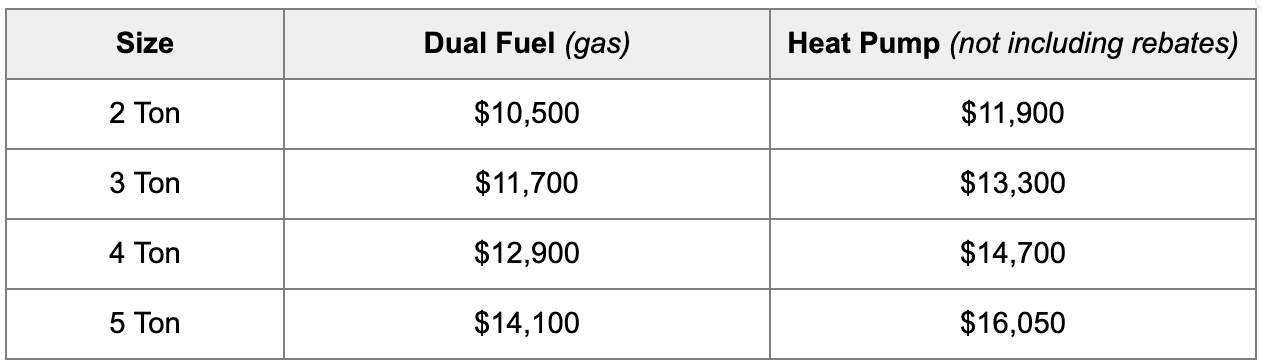
These prices include all the typical expenses listed above. They are based on a well-run, medium-sized family business in Arizona in 2026 and reflect a manufacturer parts warranty of 10 years on the AC, and 20 years on the heat exchange, along with a labor warranty of 2 years. They are neither the lowest or the highest priced systems available, but a sound estimation of the most common product purchased in Arizona in 2026.
2026 Split AC System Pricing
Split AC systems are a three-piece design, making them a bit more expensive. The furnace is a separate unit that goes inside a closet, garage, or attic. A well-maintained split AC system should last 20 to 25 years, and with proper preventative maintenance, we've seen them last 35-40 years without drama. The installation quality and environmental conditions will dictate the future of your new Split HVAC system.
While there is an argument that you could use the existing heat exchanger with a new evaporator coil and condenser, this isn’t a scenario without challenges. As technology changes, buyers run the risk of being unable to match a furnace to their system later, forcing them into a difficult and expensive replacement of all their equipment.
Because the blower motor is in the furnace, you have to have all the bits and pieces match up to work properly. The following prices include the cost of the furnace:
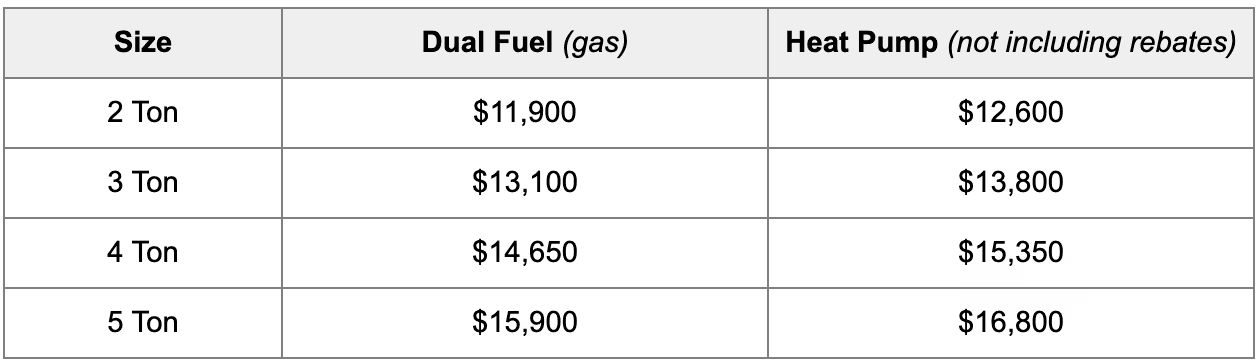
These prices include all the typical expenses listed above. They are based on a well-run, medium-sized family business in Arizona in 2026 and reflect a manufacturer parts warranty of 10 years on the AC, and 20 years on the heat exchange, along with a labor warranty of 2 years. They are neither the lowest or the highest priced systems available, but a sound estimation of the most common product purchased in Arizona in 2026.
PRO TIP: There's no such thing as a free furnace. That's just bad (and illegal, by the way) marketing by people who believe consumers are stupid.
2026 Ductless Mini-Split System Pricing
As the name implies, these systems do not require ductwork to function. They condition the air from evaporator coil “heads” that you place in specific rooms. You can run the air conditioner normally to cool the space and in reverse to heat the space.
Ductless mini-split systems are fantastic for homes without ductwork or where adding ductwork is cost-prohibitive (or unsightly). Mini-splits are most often used in Arizona as supplementary cooling and heating solutions to improve the comfort of specific spaces.
A well-maintained ductless mini-split AC system should last 12 to 17 years, and with proper preventative maintenance, we've seen them last 22 years. They are a little more finicky than a split AC system, and all the heads will need annual maintenance, but on the upside, there are no ducts to clean. As you might have guessed, the installation quality and environmental conditions determine your mini-split's lifespan.
Ductless mini-split systems are excellent for Arizona weather 98% of the time. Where they fall short is when you need them most, extreme heat and cold. This is often why they act as a support to a primary, ducted AC system but won't steer you wrong most of the time.
In a pinch, with the money you save on these units, you can afford some space heaters and ice cream.
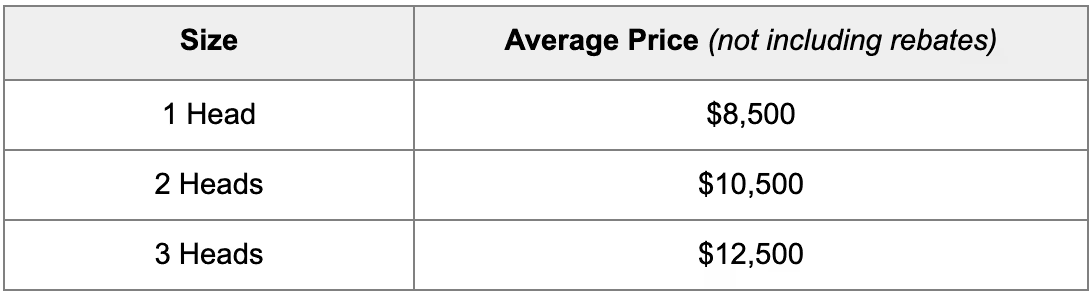
These prices include all the typical expenses listed above. They are based on a well-run, medium-sized family business in Arizona in 2026 and reflect a manufacturer parts warranty of 10 years on the AC and heat exchange, along with a labor warranty of 2 years. They are neither the lowest or the highest priced systems available, but a sound estimation of the most common product purchased in Arizona in 2026.
To Replace or Repair? That’s The Real Question.
I have a real issue with these greedy companies that are so desperate to feed the giant mutant they've raised. Don't get me wrong, I respect a well-run, efficient company that does good work, no matter its size.
What I detest are companies that are willing to do anything to generate revenue out of greed and desperation. They’re not here to serve the community. My community. Our Community! They're here to bleed it dry and go back to Wall Street with everyone's money, regardless of the human cost.
These out-of-state private equity companies don't care about anything or anyone but themselves. They run their business from a spreadsheet. This leads them to manipulate unsuspecting people into purchasing new equipment way before it is truly necessary.
These morally corrupt companies are putting Americans in a tough spot financially, and they don't care. Certainly, there comes a time when you need to replace your system, but at least look at what a reasonable repair cost would be first.
Not a band-aid. Not a parts replacement exercise.
A proper repair. Fixed fixed.
There is no legitimate energy-saving graph, cost analysis case study, or "ROI" explanation that can justify buying a new system prematurely. Yes, even a 10-year-old system. Or a 15-year-old system.
It's nonsense disguised as math. It's trickery. It's snake oil.
Preventative maintenance and lasting repairs will always win the real math game. Strangely enough, those scenarios are never presented in the slick pitch to convince you to part with your hard-earned cash.
How do I know? Because I have an old system. Really old. And my bills aren't exorbitant. And repairing it is still reasonable. And a little preventative maintenance is often as good as a cure.
So that's how I've decided to run my AC repair company.
I'm Frankie, and I'd love to be your AC Repair Guy. We’ll replace it when we have to, but not before. It’s your call.


